One Human. 100 AI Agents. Welcome to the Company of the Future.
Stop Hiring Bots. Start Building an AI Team.
Why the Next Great Company May Be a Small Human Team Directing an Always-On Workforce of Specialized AI Agents
For the past few years, most of us have interacted with artificial intelligence as if it were a very talented individual sitting across the desk.
Ask ChatGPT a question. Give Claude a document. Ask a coding model to build something. Generate an image. Conduct some research.
Useful? Absolutely.
But that may not be the organizational model that ultimately changes business.
A much more consequential idea is emerging: instead of one human using one AI assistant, what happens when a small human team manages an entire team of specialized AI agents?
One agent develops software. Another conducts research. Another manages projects. Another writes and markets. Different models are selected for different jobs. They share business context, communicate with one another, use real tools and maintain persistent responsibilities. Humans remain responsible for direction, judgment, taste and consequential decisions.
The transcript behind this article documents an experiment built around exactly that idea: a Mac Mini, cloud infrastructure, specialized agents, shared workspaces, project management tools and multiple AI models assembled into something resembling an actual digital organization.
The important story isn’t the particular hardware or software.
It’s the organizational model underneath it.
The next great company may look strangely small—not because it does less, but because every human may eventually direct an enormous amount of machine labor.
From AI Assistant to AI Organization
Most AI adoption still follows a simple pattern:
Human → AI → Output
You ask. AI responds. You review. You copy the result somewhere else.
The next model looks different:
Human → AI Manager → Specialized Agents → Tools → Workflows → Verification → Output
That is a profound transition.
Instead of repeatedly telling an AI what to do, businesses begin creating persistent digital workers with defined roles.
A developer agent doesn’t merely answer occasional programming questions. Development is its job.
A marketing agent isn’t just asked to write a post. It understands the brand, content pipeline, audience and campaigns.
A project-management agent doesn’t merely summarize a meeting. It tracks projects, updates tasks, identifies blockers and coordinates work.
The transcript describes building agents with their own responsibilities, tools, memories, instructions and skills—and then bringing them into a shared environment with human teammates.
That distinction matters.
We are moving from using AI toward organizing AI.
The Real Bottleneck Isn’t Intelligence. It’s Coordination.
This may become one of the most important lessons of the agent era.
You can have five brilliant AI systems and still have a terrible organization.
Why?
Because intelligence alone doesn’t create coordinated work.
Imagine hiring five extraordinarily talented people and placing each one in a different building without allowing them to communicate.
One researches the market.
Another builds the product.
Another creates marketing.
Another manages customers.
Another analyzes the business.
But nobody knows what anyone else is doing.
You—the owner—spend your entire day copying information between them.
That is surprisingly close to how many people currently use AI.
The transcript describes exactly this problem. Individual agents could perform useful work, but they remained isolated. One agent didn’t know what another was doing, human team members lacked a common collaboration space, chat threads became fragmented, and context had to be manually transferred between conversations.
The solution isn’t necessarily a smarter model.
It is a coordination layer.
That means shared:
context + communication + projects + memory + tools + permissions + audit trails
The AI revolution therefore isn’t merely creating a market for better intelligence.
It is creating a market for AI organizational infrastructure.
Don’t Hire One Super-Agent
There is another important lesson in the transcript: different models behave differently and may be better suited to different kinds of work. The creator describes deliberately matching different models and agent systems to development, planning, reasoning, writing, research and creative work rather than assuming every AI is interchangeable.
That’s a useful organizational analogy.
You wouldn’t build a human company by hiring 20 identical people.
Why build an AI company that way?
The emerging model could resemble:
AI Project Manager
Coordinates projects, assignments and deadlines.
AI Developer
Writes, tests and maintains code.
AI Researcher
Searches, compares sources and produces intelligence.
AI Marketer
Creates campaigns, content and positioning.
AI Designer
Produces creative concepts and visual directions.
AI Analyst
Monitors performance and identifies opportunities.
AI Operations Agent
Handles repetitive workflows and administrative processes.
AI Critic / Verification Agent
Challenges assumptions and checks the work of other agents.
The human increasingly becomes the director of this organization.
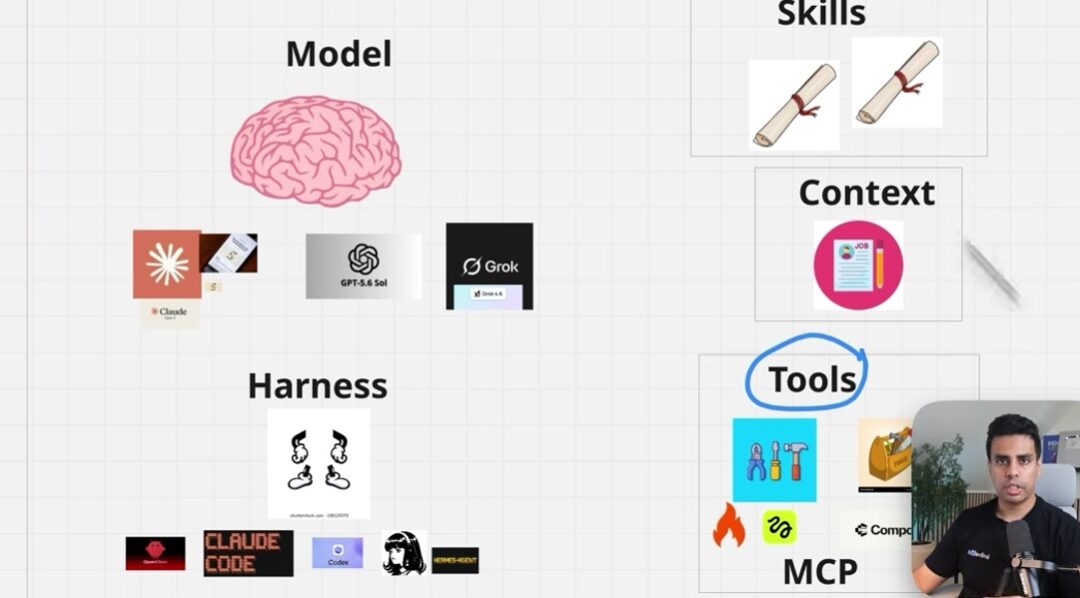
Models Are Brains. Agents Are Workers.
One of the useful distinctions in the transcript is between the model, the software surrounding that model, and the resulting agent.
A model provides intelligence.
But intelligence alone doesn’t make an employee.
An agent becomes much more useful when intelligence is combined with:
a role, instructions, context, memory, tools, skills and permissions.
Think of the model as the brain.
The surrounding agent system becomes the body.
Tools become the hands.
Memory provides experience.
Instructions provide responsibilities.
Business data provides context.
Permissions define authority.
And the shared workspace becomes the office.
This is why the future of AI may not be won exclusively by whoever produces the highest-scoring foundation model.
There is an enormous layer emerging around the models.
Your AI Agents Need an Office
This is one of the more interesting ideas demonstrated in the transcript.
Agents may execute on local machines or cloud computers, but they also need somewhere to collaborate.
The creator uses Buzz as that shared environment, bringing together human team members, multiple specialized agents, projects, channels, conversations and context. The transcript describes features such as an inbox, projects, agent profiles, channels, direct conversations and agent teams.
The larger concept matters more than any one platform.
Slack gave human teams a digital office.
GitHub gave developers a collaborative environment.
Salesforce organized customer relationships.
Asana, Monday and ClickUp organized projects.
The agent economy may require something that combines elements of all of them:
An AI Workforce Operating System
Humans and agents log into the same organization.
Everyone has roles.
Everyone has permissions.
Everyone can see relevant projects.
Agents can communicate.
Humans can intervene.
Activity is logged.
Knowledge persists.
Tasks move between humans and machines.
Suddenly AI doesn’t feel like a collection of websites.
It starts feeling like a company.
Your Mac Mini Becomes a Home for Digital Workers
The transcript also raises a practical architectural question: where should all these agents actually live?
One option is local hardware such as a Mac Mini. Another is cloud infrastructure such as a virtual private server (VPS). The experiment eventually separates some agent workloads from the shared collaboration infrastructure, with cloud hosting providing an always-on centralized environment for databases, media, shared services and collaboration.
This suggests an intriguing near-future computing model.
Your laptop is for you.
Your Mac Mini—or another dedicated computer—is for your agents.
Cloud infrastructure becomes their shared office.
Suddenly the personal computer evolves into something closer to a:
Personal AI Data Center
Instead of buying a computer because you need more computing power, you may buy computers because your digital workforce needs somewhere to operate.
That could become an entirely new consumer-computing category.
Local AI + Cloud AI May Beat Either One Alone
The choice doesn’t necessarily have to be local or cloud.
The more interesting architecture may be hybrid.
Local hardware can provide dedicated environments, local files, persistent processes and greater control over certain workloads.
Cloud infrastructure provides always-on availability, centralized collaboration and easier access for distributed teams.
Frontier AI models provide intelligence.
Agent harnesses provide tools and execution.
Shared workspaces coordinate everything.
The result looks less like an app and more like an information system:
Human Director
↓
AI Workforce OS
↓
Agent Manager
↓
Specialized Agents
↓
Models + Memory + Tools
↓
Local Machines + Cloud Infrastructure
↓
Business Applications
That is a dramatically richer architecture than “open ChatGPT and type something.”
AI Agents Need Real Tools
An employee who can think but cannot touch anything isn’t especially useful.
Neither is an AI agent.
The transcript emphasizes connecting agents to external tools and services so they can actually execute tasks rather than merely describe what someone else should do.
This is the difference between:
“Here is how you could update the project.”
and:
“I updated the project.”
Or:
“Here is the research you should perform.”
versus:
“I researched it, organized the findings, created the task and notified the team.”
That small linguistic difference represents an enormous economic transition.
Chatbots produce answers.
Agents produce actions.
Agent teams can potentially produce workflows.
The AI Project Manager
The transcript provides a concrete example by creating an AI project manager and connecting it to a project-management system.
The agent is instructed to manage projects, agents and tasks, and the resulting work becomes visible in the project dashboard.
Imagine taking that further.
Every morning, the project-manager agent examines:
what was completed yesterday,
what remains blocked,
which agent is overloaded,
which deadlines are approaching,
what requires human approval,
and what should happen next.
It then distributes work.
The researcher begins researching.
The developer starts building.
The marketer drafts the launch.
The analyst checks yesterday’s performance.
You wake up and receive an executive summary.
That is where the concept becomes powerful.
You’re no longer prompting every task.
You’re managing objectives.
Let Your AIs Argue
One of the most interesting experiments in the transcript involves multiple AI systems debating a business question rather than relying on a single answer.
Different agents take different perspectives, challenge one another and eventually produce a recommendation.
That could become a surprisingly important pattern.
Instead of:
Ask AI → Accept answer
we get:
Ask Agent A
↓
Agent B challenges it
↓
Agent C searches for weaknesses
↓
Verification agent checks evidence
↓
Manager agent synthesizes
↓
Human decides
Think about applying this to:
product strategy,
investments,
marketing campaigns,
legal questions,
software architecture,
hiring,
business acquisitions.
The value of multiple agents isn’t merely that they can perform more work simultaneously.
They can provide cognitive diversity.
Welcome to Multiplayer AI
This may be a better way to describe the transition.
Most AI today is essentially single-player.
One human.
One conversation.
One AI.
The next generation is multiplayer AI:
multiple humans + multiple agents + shared context + shared tools + shared goals
A human employee can ask the research agent for help.
The research agent can hand findings to the marketing agent.
The marketing agent can ask the designer for an asset.
The project manager sees the entire process.
The human director only gets pulled in when judgment or authorization is required.
The transcript emphasizes how bringing humans and agents into the same environment makes this collaboration tangible and auditable.
That may ultimately matter more than another incremental improvement in chatbot intelligence.
The Small-Team Revolution
The economic implications could be enormous.
Historically, increasing output usually required increasing headcount.
More customers required more support representatives.
More software required more developers.
More content required more writers.
More projects required more managers.
AI begins breaking that relationship.
The transcript’s central business insight is that humans can continue providing judgment, direction and taste, while agents take on substantial portions of research, drafting, coordination, execution and publishing. The stated goal is a smaller human team capable of moving faster and potentially producing more with lower overhead.
That leads to a provocative possibility:
The defining metric of the AI economy may become output per human.
Imagine a 10-person company directing 100 agents.
Then 500.
Then 1,000.
Those agents don’t necessarily replace 1,000 employees one-for-one.
But they dramatically expand what those ten humans can attempt.
The Human Job Moves Up the Stack
This doesn’t make humans irrelevant.
It changes where humans create value.
Machines increasingly handle:
research,
drafting,
formatting,
monitoring,
routine coding,
data movement,
administration,
repetitive execution.
Humans concentrate on:
judgment
taste
relationships
strategy
ethics
priorities
leadership
original vision
That may become one of the defining management transitions of the next decade.
The valuable employee isn’t necessarily the person who can personally execute every task.
It may increasingly be the person who can design the system that gets the task done.
Become the AI Director
This gives us a useful new job description.
Not prompt engineer.
Not chatbot user.
Not even agent builder.
AI Director
The AI Director asks:
What are we trying to accomplish?
Which work should humans do?
Which work should agents do?
Which model is best for each role?
What tools should each agent have?
What information should it remember?
What permissions should it receive?
Which actions require approval?
Which agent verifies the work?
When should a human intervene?
This resembles directing a film.
The director doesn’t operate every camera, build every set, edit every frame, write every line and perform every role.
The director orchestrates specialists toward a coherent outcome.
That may increasingly describe entrepreneurship itself.
But Autonomy Requires Guardrails
The more capable agents become, the more important permissions become.
A research agent reading public websites is one thing.
An agent capable of publishing content, modifying production code, accessing customer databases or spending company money is something entirely different.
The transcript explicitly raises this question early: what should agents be able to access, and what safeguards should surround them?
The principle should be simple:
Give an agent enough authority to perform its job—but not enough authority to destroy the business.
That means organizations will need:
least-privilege access,
isolated credentials,
approval thresholds,
tool allowlists,
spending limits,
audit logs,
sandboxed environments,
human escalation.
The AI workforce needs an HR department.
It also needs an IT security department.
The Biggest Opportunity May Be the Management Layer
The obvious AI businesses today are foundation models and applications.
But consider everything required for an organization running hundreds of agents:
Agent identity.
Agent communication.
Memory.
Permissions.
Security.
Task routing.
Cost management.
Model selection.
Observability.
Performance measurement.
Collaboration.
Human approvals.
Agent reputation.
Audit trails.
This could become an enormous software category.
Companies won’t merely ask:
Which AI model should we buy?
They’ll ask:
How do we manage our AI workforce?
That sounds remarkably similar to the evolution of enterprise software around human workforces.
From SaaS to AaaS: Agents as a Service
Software-as-a-Service gave every company access to sophisticated software without installing its own infrastructure.
Agents could create another shift:
Agents-as-a-Service.
Instead of purchasing project-management software, perhaps you hire an AI project manager.
Instead of buying analytics software, you hire an analyst agent.
Instead of subscribing to an SEO tool, you employ an SEO agent that uses multiple tools.
The interface moves from:
dashboard → buttons → human operation
toward:
objective → agent → execution
That could put pressure on traditional SaaS itself.
Why learn complicated software if your agent can operate it for you?
The Company Becomes an Agent Network
Push the idea far enough and something fascinating happens.
A company stops looking like a hierarchy of people using software.
It begins looking like a network of:
humans + agents + models + tools + data + machines
Work flows dynamically between them.
Some tasks are performed by people.
Some by one agent.
Some by swarms.
Some by specialized models.
Some are challenged by other agents.
Some require human approval.
The organization itself begins to resemble a living computational system.
And that may be the larger meaning of the experiment documented in this transcript.
It’s not really about putting a few bots on a Mac Mini.
It’s about discovering what happens when intelligence itself becomes an organizational resource that can be assigned, specialized, coordinated and scaled.
The 10-Person Billion-Dollar Company?
For years, Silicon Valley has speculated about whether AI could enable a billion-dollar company with only a handful of employees.
The idea sounds less absurd once you stop imagining ten humans doing all the work.
Imagine instead:
10 humans
50 core agents
500 temporary specialist agents
thousands of automated workflows
millions of machine-executed tasks
The humans provide vision, capital, relationships, leadership and judgment.
The machines provide enormous amounts of execution.
That doesn’t guarantee the mythical ten-person unicorn.
But it changes the economics enough that the possibility deserves serious attention.
The next great company may look strangely small from the parking lot—and enormous from inside its digital workforce.
The Bigger Shift: From Managing People to Managing Intelligence
The industrial revolution scaled physical labor.
Computers scaled calculation.
The internet scaled information.
Cloud computing scaled software.
AI agents may scale cognitive labor.
And once cognitive work becomes something that can be provisioned, assigned and orchestrated like computing resources, the structure of companies begins to change.
The entrepreneur of the future may wake up, open a command center and see:
12 humans online.
184 agents active.
37 projects running.
2,481 tasks completed overnight.
14 decisions awaiting approval.
3 agents requesting additional permissions.
1 strategy council debating a new product.
That is not simply automation.
That is a different way of organizing economic activity.
Final Thought: Don’t Just Use AI. Direct It.
The first phase of generative AI taught millions of people how to talk to machines.
The next phase may teach us how to manage them.
The competitive advantage won’t necessarily belong to the company with the most employees—or even the company using the smartest single model.
It may belong to organizations that become exceptional at combining:
the right humans + the right agents + the right models + the right tools + the right memory + the right safeguards.
The future company may be smaller, faster and stranger than the organizations we’re accustomed to.
And its CEO may spend less time managing tasks and more time directing intelligence.
“Don’t build a company where every human uses AI. Build a company where humans and AI operate as one coordinated team.”
That is the leap from the AI assistant to the AI organization—and it may prove far more important than the chatbot revolution that started it.