The Future Won’t Just Answer You. It Will Build, Drive, and Work Beside You.
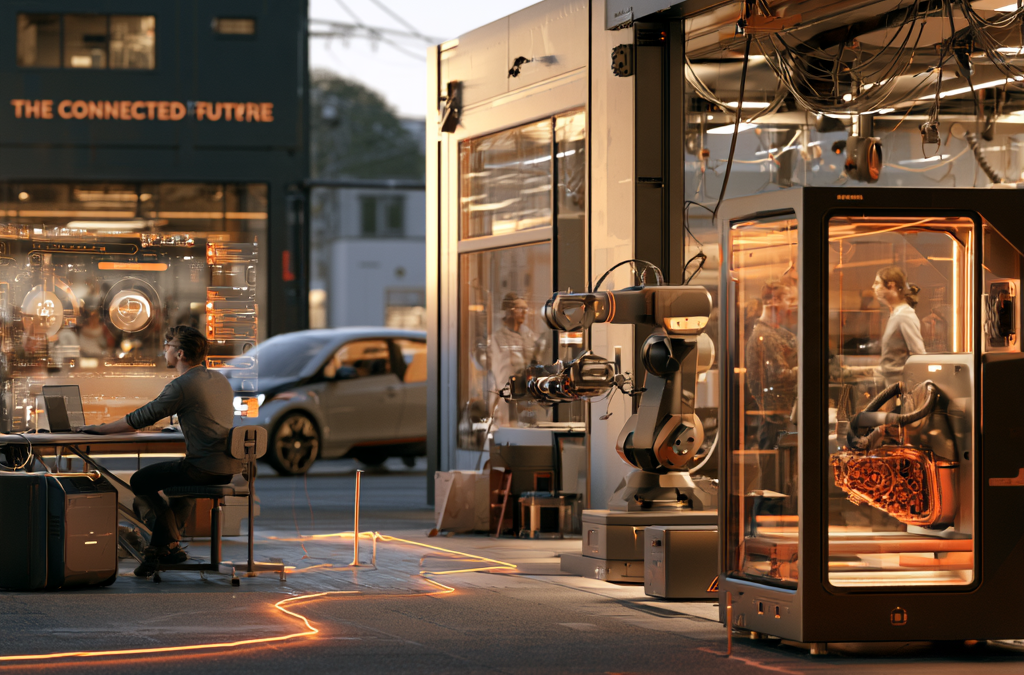
AI, autonomous vehicles, agents, robotics, and 3D printing are beginning to connect. Their combined impact could change how we work, what we own, and who gets to create.
Imagine your washing machine breaks.
Today, that might mean searching for a technician, waiting for an appointment, discovering a replacement part is unavailable, and wondering whether buying another machine would be easier.
Now imagine a different sequence.
With your permission, a diagnostic system identifies the likely fault. Your AI assistant checks the warranty, compares repair options, and presents a price. A local manufacturer produces a suitable replacement component from an authorized design. An automated delivery service brings it to the technician.
You approve the repair. Much of the coordination happens in the background.
This is a possible future, not a service universally available today. Some pieces already exist separately. Connecting them reliably remains difficult.
But the scenario illustrates something larger than a smarter chatbot: technologies that connect human intentions to physical outcomes.
AI helps interpret the problem. Agents coordinate the steps. Autonomous vehicles move things. Robots manipulate them. And 3D printers manufacture certain objects from digital designs.
Each technology matters individually. Their interaction may matter more.
“The next great interface may be the distance between saying what you need and seeing it happen.”
Intelligence is moving beyond the screen
For much of the internet era, digital technology helped us find information, communicate, and organize transactions.
We could compare products instantly, but someone still had to manufacture and deliver them. We could book a service online, but someone still had to perform it.
AI is beginning to extend that relationship.
An AI model can help interpret instructions or generate a design. An agent can use tools to pursue a task. Robotics connects computation to physical movement.
Google DeepMind’s Gemini Robotics research combines visual understanding, language, and action to help robots interact with the physical world. That is a meaningful direction, although it does not mean robots can reliably perform every household or workplace task.
This shift makes practical education increasingly useful. Projects such as Blaze Fish provide a place to explore the question behind the excitement: what work could an AI agent actually help someone accomplish?
As systems gain more ability to act, the instructions we give them become more consequential. “Find the cheapest option” and “find the most dependable option within this budget” may produce very different decisions.
AI agents could become everyday coordinators
A useful agent does more than produce convincing paragraphs. It can work through a task, interact with permitted tools, and adjust its next step based on the result.
Anthropic distinguishes predefined workflows from agents that direct their own processes and tool use. Its engineering guidance emphasizes starting simply and adding complexity when it improves the outcome.
For a small business, that could mean preparing tomorrow’s appointments, identifying missing information, organizing inquiries, or drafting follow-ups.
The opportunity for an AI automation business such as Alphire lies in connecting those capabilities to specific business needs: fewer neglected inquiries, clearer processes, and less repetitive administration.
The difficult work is making the system dependable. An assistant drafting an email and an assistant making a commitment require different levels of authority.
“The value of an AI agent is measured in useful work completed—and how much checking it still needs.”
Autonomous driving could change our relationship with distance
Self-driving vehicles attract attention because the steering wheel moves without a person controlling it.
The larger implications concern access and time.
Waymo already offers autonomous ride-hailing in supported service areas. That establishes a real commercial use while leaving considerable distance between geographically limited deployment and vehicles that can drive everywhere under all conditions.
For someone who cannot drive, dependable transportation could mean greater independence. For a family, it could change how appointments, errands, and visits are organized.
But convenience alone does not determine whether transportation improves a community.
Empty vehicles could add traffic. Autonomous trips could compete with public transportation. Pricing could leave some people excluded.
The question extends beyond whether a vehicle can drive itself: what kind of transportation system are we building around it?
Robotics brings physical consequences
Digital work allows relatively forgiving experimentation.
Robots face weight, friction, clutter, fragile objects, and unpredictable people. A misplaced sentence can be edited. A dropped object may break.
That difference explains why a compelling demonstration and a dependable deployment are separate achievements.
Some valuable robots may look unremarkable: a machine transporting supplies, a specialized arm performing one operation consistently, or a device inspecting equipment in an unpleasant environment.
Their value comes from the work they accomplish.
Their social impact depends on how they are introduced. Workers could gain safer conditions and better responsibilities. They could also face displacement or intensified monitoring.
Technology does not choose the employment arrangement. People and institutions do.
3D printing could make production more personal
Traditional manufacturing often rewards producing large quantities of the same thing.
Additive manufacturing offers different possibilities: complex shapes, rapid design changes, customization, and certain forms of lower-volume production. NIST identifies these among the technology’s advantages.
Combine those capabilities with AI-assisted design, and more people may be able to explore physical products without starting with a conventional factory.
Following developments through 3D Printing Channel and exploring the business questions through 3D Printing MBA offers two ways into this intersection of technology and entrepreneurship.
A designer might test several product versions. A workshop might develop specialized fixtures. A repair business might investigate suitable replacement components.
Yet a plausible design still needs appropriate materials, tolerances, testing, and quality control. Printing an object successfully does not establish that it is suitable for its intended use.
“When design becomes easier, knowing what is worth making becomes more important.”
Bioprinting raises an even bigger possibility
The relationship between digital design and physical production becomes especially thought-provoking when living materials enter the picture.
Bioprinting involves depositing cells and biomaterials to create structures for research and potential biomedical applications. It should not be confused with a world in which replacement organs can simply be printed on demand.
For readers interested in that frontier, Bioprinting World is a related project to explore alongside the wider manufacturing conversation.
The questions become profound: how do we establish that a living structure works as intended? How do we make advanced manufacturing useful to patients? And who gets access if the technology succeeds?
Here, progress demands biological understanding and validation as much as better hardware.
Small businesses could attempt bigger things
Picture a hypothetical company producing customized accessories.
An agent organizes customer requirements. AI helps explore design options. A person approves the specification. A production partner manufactures the item. Automated equipment assists with handling or inspection, and a delivery network brings it to the customer.
The appeal is ordinary: fewer delays between understanding a need and meeting it.
For entrepreneurs exploring ideas through 3D Printing Ventures, the opportunity could involve specialized products, production services, inspection, repair, training, or coordination between existing providers.
Owning every machine may be unnecessary. Understanding a customer’s problem—and organizing a dependable solution—could be more valuable.
Lower barriers also invite more competition. When more people can generate acceptable designs and marketing, expertise, trust, and service become stronger reasons to choose one business over another.
Who owns the future’s productive capacity?
Cheaper intelligence and greater automation could make some goods and services more accessible.
They will still depend on electricity, materials, infrastructure, maintenance, and manufacturing capacity. A fast digital process can encounter a slow physical bottleneck.
And greater productive capacity does not guarantee broadly shared benefits.
If a few platforms control the models, fleets, production networks, and customer relationships, many businesses could become dependent on infrastructure they do not own.
Who controls the data? Can customers switch providers? Can independent technicians repair the machines? Who is accountable when an automated decision causes harm?
“A more automated world is not automatically a more independent one.”
These questions deserve public participation. A project such as Normie offers a natural connection to that discussion: inviting people to consider how emerging technology should serve communities, workers, and everyday life.
Human judgment becomes more consequential
When producing a draft, design, or plan takes less effort, choosing what deserves to be produced becomes more important.
A system can optimize a measurable objective. People must decide whether that objective reflects what they value.
A city can pursue faster traffic or more livable streets. A company can pursue lower costs or better service. A household can pursue maximum convenience or greater privacy.
Those goals sometimes align. Sometimes they conflict.
We need people who can recognize the tradeoffs, evaluate evidence, and take responsibility. We also need practical expertise: someone must recognize an implausible diagnosis, an unsuitable component, or an automated workflow solving the wrong problem.
Understanding the work remains a source of power.
The future will arrive unevenly
A company may automate paperwork while its physical operations remain largely unchanged. A neighborhood may have driverless rides alongside unreliable infrastructure. A factory may use advanced robotics while struggling with familiar supply problems.
Extraordinary capabilities will exist beside ordinary frustrations.
That makes careful observation more useful than sweeping predictions: which tasks work reliably, at what cost, under which conditions, and for whose benefit?
AI, agents, autonomous vehicles, robotics, and 3D printing could shorten the distance between having an idea and making it real.
As more intentions become executable, we need to become more deliberate about the intentions we choose.
When we can make more things happen, what will we decide is worth making happen?