One Goal Can Change a Nation
Every World Cup begins with tactics, formations, rankings, betting odds, and predictions. Analysts study pressing systems. Fans argue over lineups. Coaches speak carefully about discipline, preparation, and execution.
But then the whistle blows.
And suddenly, the entire tournament can be reduced to something much simpler:
One ball.
One run.
One mistake.
One finish.
One goal.
That is the magic of the World Cup. It is not just a soccer tournament. It is a global emotional machine, capable of turning a single moment into a national memory. A goal in a league match can win three points. A goal in the World Cup can rewrite a player’s life, lift a country’s mood, revive old pride, heal old wounds, or create a story that grandparents will tell grandchildren decades later.
In most sports, greatness is measured over time. Seasons. Careers. Statistics. Championships. But the World Cup has a different kind of power. It compresses history into seconds. A player may spend twenty years chasing perfection, but the world may remember him for one touch in one match on one summer night.
That is why the World Cup feels so different from everything else.
It is where pressure becomes poetry.
The Goal Is Never Just a Goal
A World Cup goal is not merely an athletic event. It is a cultural explosion.
When a player scores for his country, the celebration does not belong only to the eleven men on the field. It belongs to the child watching in a crowded living room. It belongs to the workers sneaking glances at a phone during a shift. It belongs to the immigrant family wearing the colors of a homeland they left years ago. It belongs to the city square packed with strangers who, for one beautiful moment, become one body, one voice, one heartbeat.
That is what separates the World Cup from club soccer. Club teams create loyalty. National teams create identity.
A club goal says, “We won.”
A World Cup goal says, “This is who we are.”
For smaller nations, one goal can be proof of existence. It can say to the world: we are here, we matter, we can compete, we will not be ignored. For football giants, one goal can carry the weight of expectation, history, and national obsession. For countries that have suffered disappointment for generations, one goal can feel like a door finally opening.
That is why people cry over goals. Not because a ball crossed a line, but because something invisible crossed with it: pride, hope, memory, belonging.
The World Cup Turns Players Into Symbols
Every World Cup produces stars, but the most unforgettable players become more than athletes. They become symbols.
One player becomes the face of national resilience. Another becomes the embodiment of creativity. Another becomes the villain in someone else’s dream. Another becomes the unlikely hero nobody expected.
This is why the World Cup is so cruel and beautiful. It does not always reward the best player or the best team. It rewards the moment. It rewards whoever can survive the pressure long enough to produce clarity when the rest of the world is shaking.
In normal life, we are told that one moment should not define us. In the World Cup, one moment often does.
A striker can miss chances all tournament and still become immortal with one goal in the final. A defender can play brilliantly for years and be remembered for one lapse. A goalkeeper can spend an entire match almost invisible, then become a national hero in a penalty shootout.
The World Cup does not care about fairness in the ordinary sense. It cares about drama.
And drama needs a single unforgettable act.
Why One Goal Feels Like Destiny
The most powerful World Cup goals often feel inevitable only after they happen.
Before the goal, there is chaos. The match is tense. The fans are nervous. The players are tired. The coach is pacing. The nation is bargaining with fate.
Then the chance arrives.
Maybe it is a cross whipped into the box. Maybe it is a counterattack. Maybe it is a free kick. Maybe it is a rebound that falls to the one player who seems born for that exact moment.
The shot leaves the foot.
For half a second, time disappears.
Then the net moves.
That is the moment the World Cup lives for.
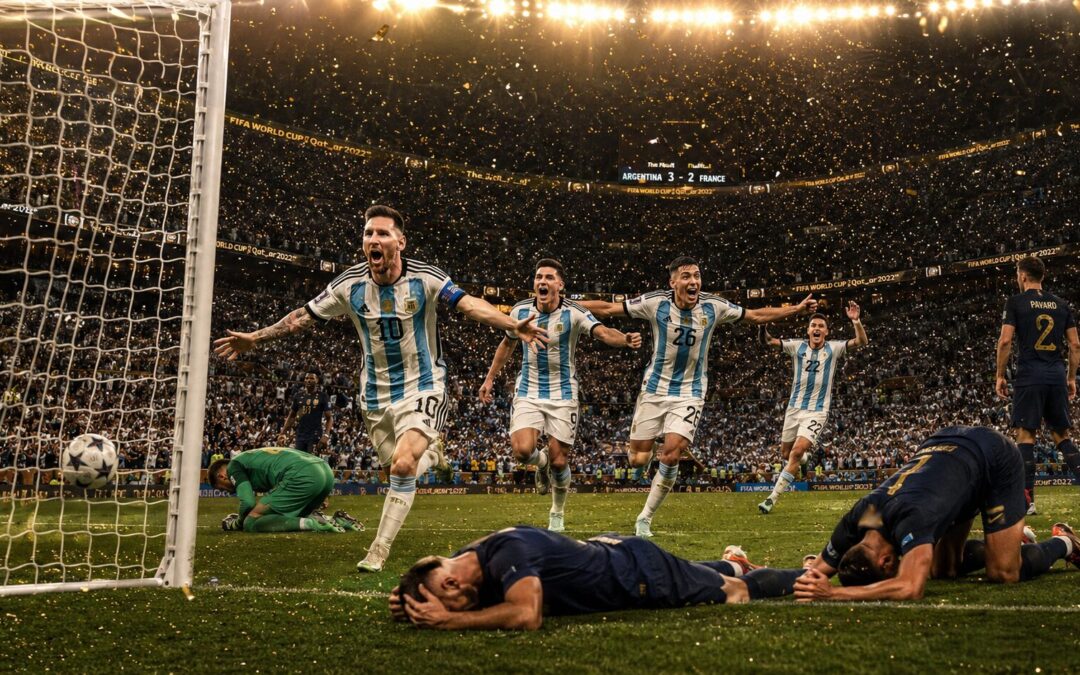
The celebration after a World Cup goal is one of the purest human scenes in modern life. It is spontaneous, tribal, emotional, and completely unfiltered. Players sprint with no plan. Teammates collapse on top of each other. Fans scream into the sky. People hug strangers. Commentators lose their voices. A country forgets its problems for a few seconds and remembers how good it feels to believe in something together.
In an age of division, cynicism, algorithms, and constant distraction, the World Cup still creates shared emotion at a scale almost nothing else can match.
One goal can make millions of people feel the same thing at the same time.
That is rare. That is powerful. That is why it matters.
The Underdog Goal Hits Different
There is no sound quite like an underdog scoring at the World Cup.
When a football superpower scores, the world respects it. When an underdog scores, the world leans forward.
Because in that moment, the impossible becomes temporarily possible. The rankings no longer matter. The payrolls no longer matter. The history no longer matters. The smaller nation is no longer just “happy to be there.” It is alive. It is dangerous. It is writing a new story in real time.
The underdog goal is one of the great democratic moments in sports. It reminds us that talent is everywhere, that belief can travel farther than resources, and that even the most polished giants can be shaken by courage.
This is why fans who have no connection to a country will suddenly support it. The World Cup turns neutral viewers into believers. We love the upset because it gives us permission to imagine that our own impossible battles might also be winnable.
The underdog goal says: history is heavy, but it is not permanent.
The Goal That Changes a Player’s Life
For the player who scores, a World Cup goal can divide life into before and after.
Before the goal, he may be known only to dedicated fans, local supporters, or scouts. After the goal, his face is everywhere. His name becomes part of national vocabulary. Children imitate him in parks. Advertisers call. Clubs pay attention. His family history is retold. His childhood neighborhood becomes part of the mythology.
But fame is only one part of it.
The deeper transformation is emotional. The player knows that he gave his country something no one can take away. Even if his career later fades, that moment remains. He has placed himself inside the permanent archive of national feeling.
That is the strange immortality of the World Cup. It does not require a perfect career. It does not require endless records. Sometimes it only requires one perfectly timed goal.
One goal can make a player a legend.
One goal can make a nation remember his name forever.
The Goal That Changes a Nation’s Mood
The World Cup also matters because nations do not arrive at tournaments as blank slates. They bring their politics, economies, wounds, frustrations, dreams, and insecurities with them.
Sometimes a country is exhausted. Sometimes it is divided. Sometimes it is searching for a new generation of heroes. Sometimes it is trying to prove that it belongs on the global stage. Sometimes it simply needs joy.
A World Cup goal cannot solve a nation’s problems. It cannot fix inflation, corruption, inequality, war, or grief. But for a moment, it can create relief. It can create unity. It can remind people that shared joy is still possible.
That may sound sentimental, but it is not small.
Human beings need moments of collective release. We need symbols. We need stories. We need reasons to gather. We need memories that are not only personal but communal.
The World Cup provides those memories.
Years later, people may not remember every statistic from a tournament. They may not remember possession percentages or expected goals. But they remember where they were when the goal went in. They remember who they hugged. They remember the sound. They remember the feeling.
That is how sport becomes history.
The Cruel Side of One Goal
Of course, if one goal can change a nation for the better, it can also break one.
For every celebration, there is silence on the other side. For every hero, there is someone on the grass staring into nothing. For every nation dancing in the streets, another is asking what went wrong.
That is the emotional bargain of the World Cup. The joy is so intense because the pain is so close.
A goal in the 90th minute can rescue a dream. It can also destroy one. A deflection can become destiny. A bad clearance can become a national trauma. A penalty can turn confidence into panic.
The World Cup is beautiful because it is unforgiving. There are no seven-game series. There is no long season to recover. There is only the moment, and the moment does not wait for anyone to be ready.
That is why the tournament feels so alive. Every match carries the possibility of permanent consequence.
Why We Keep Coming Back
The World Cup endures because it understands something deep about human nature: we are storytelling creatures.
We do not watch only to see who wins. We watch to see who becomes brave. We watch to see who collapses under pressure and who rises above it. We watch to see whether the favorite can carry the weight, whether the underdog can shock the world, whether the aging legend has one more miracle, whether the young star is ready to inherit the stage.
And above all, we watch because we know one goal can change everything.
One goal can turn a quiet teenager into a national icon.
One goal can make a country believe again.
One goal can erase years of disappointment.
One goal can start a celebration that spills from stadiums into streets, from streets into memory, from memory into myth.
That is the power of the World Cup.
It is not just about who lifts the trophy at the end. It is about the moments that make people feel larger than themselves. It is about the instant when a nation holds its breath, the ball hits the net, and life briefly becomes something like magic.
Because in the World Cup, one goal is never just one goal.
It is a heartbeat.
It is a story.
It is a nation, suddenly changed.