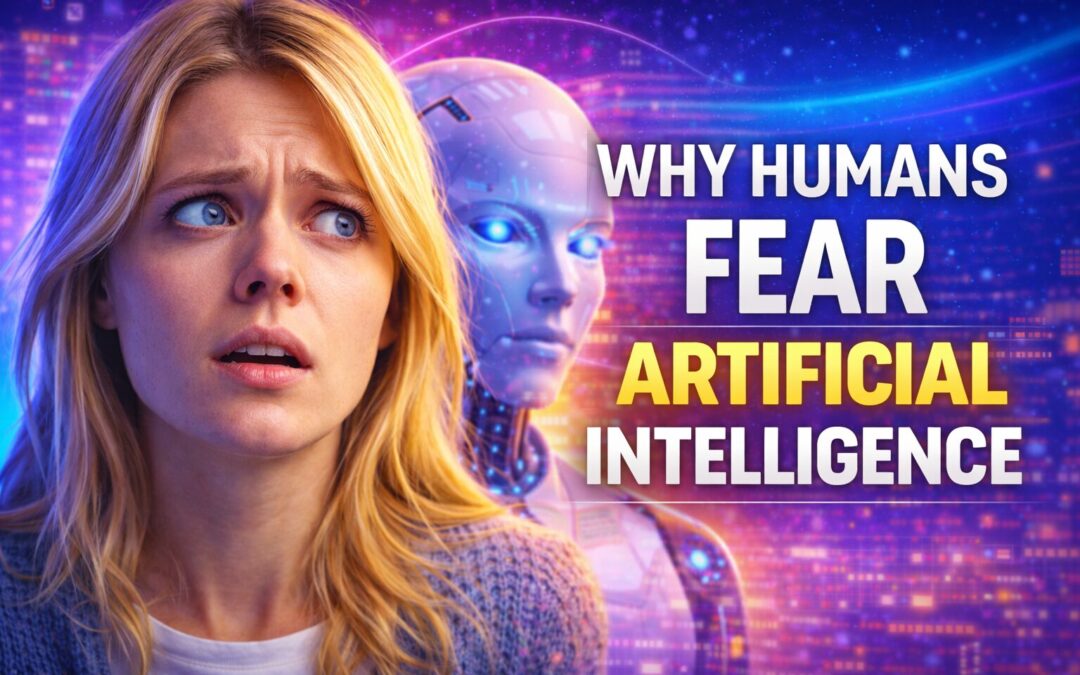
Why Humans Fear Artificial Intelligence
The Psychology of Intelligence, Control, and the Unknown Future
Humanity has always feared the unknown.
From the first lightning storm to the first nuclear weapon,
every major technological leap has produced both hope and anxiety.
Artificial intelligence may be the most psychologically powerful leap of all.
Not because it is simply a new tool.
But because it challenges how humans define themselves.
Why Humans Fear Artificial Intelligence
The First Technology That Thinks
For thousands of years, humans created tools to extend physical strength.
Axes extended the arm.
Cars extended the legs.
Machines extended muscle power.
But artificial intelligence is different.
It extends the mind.
It performs tasks once considered uniquely human —
writing, designing, analyzing, learning.
This triggers a deep psychological reaction.
Because intelligence has long been humanity’s core identity.
When something else begins to share that ability,
it forces a reevaluation of what it means to be human.
Fear of Losing Control
At a biological level, humans are wired to seek control.
Predictability equals safety.
Uncertainty equals risk.
Artificial intelligence introduces systems that operate autonomously,
often in ways that are difficult for non-experts to fully understand.
Algorithms make decisions.
Models generate outcomes.
Machines learn patterns without explicit instructions.
This creates a subtle but powerful tension.
People begin to feel that technology is no longer just being used —
it is becoming an independent force.
Even when this perception is exaggerated,
the emotional response is real.
Fear often arises not from actual danger,
but from the feeling of losing influence over the future.
The Existential Threat Narrative
Artificial intelligence activates a deeper fear than job loss or economic change.
It activates existential anxiety.
If machines can perform intellectual work,
what role remains for humans?
This question touches identity, purpose, and meaning.
Throughout history, human worth has often been linked to productivity and capability.
When those foundations appear uncertain,
people may experience psychological instability.
This is not simply a technological transition.
It is an identity transition.
Humanity is being asked to redefine value beyond efficiency.
The Speed of Change
Another major driver of fear is acceleration.
Technological progress used to unfold across generations.
Now it unfolds across months.
New AI capabilities emerge continuously:
Language generation.
Medical diagnostics.
Autonomous systems.
Creative production.
The human nervous system did not evolve for this pace.
When change occurs faster than adaptation,
the brain enters a state of heightened alert.
This can manifest as anxiety, skepticism, or resistance.
Fear becomes a natural response to rapid transformation.
Cultural Stories and Collective Imagination
Fear of artificial intelligence is amplified by storytelling.
For decades, popular culture has explored scenarios where machines surpass human control.
Films, novels, and media narratives often portray AI as a rival intelligence —
cold, calculating, and indifferent to human well-being.
These narratives shape expectations.
Even when real-world AI is collaborative and beneficial,
the imagination can project dystopian outcomes.
Humans often fear what they can vividly imagine,
even more than what is statistically likely.
Economic and Social Uncertainty
Artificial intelligence also introduces practical concerns.
Automation may disrupt labor markets.
New skills will be required.
Traditional career paths may become unstable.
Work is not only a source of income.
It is a source of structure and social belonging.
When the future of work feels uncertain,
fear naturally increases.
People worry about their place in an evolving economic system.
This anxiety can extend beyond individuals to entire communities.
The Transparency Problem
Many AI systems operate as complex “black boxes.”
They generate results without easily explainable reasoning.
For humans, trust is often built on understanding.
When technology produces outcomes that cannot be intuitively explained,
it creates psychological distance.
People may feel that decisions are being made by invisible forces.
This perception can reduce confidence and increase suspicion.
Building transparent and ethical AI systems will be essential
to reducing this fear over time.
A Turning Point in Human Evolution
Despite these concerns, artificial intelligence also represents opportunity.
It can enhance scientific discovery.
Improve healthcare.
Expand education.
Reduce repetitive labor.
The real challenge is not whether AI will change society.
It is how humans will choose to guide that change.
Fear can be destructive if it leads to paralysis.
But it can also be constructive if it leads to thoughtful preparation.
Understanding emotional reactions to AI is part of adapting to a new era.
Redefining Human Value
Artificial intelligence may ultimately push humanity toward deeper questions.
If productivity becomes automated,
what becomes the measure of a meaningful life?
Possibilities include:
Creativity.
Empathy.
Conscious awareness.
Ethical responsibility.
Personal growth.
The future may reward qualities that machines cannot easily replicate.
Rather than replacing human purpose,
AI may shift it.
The Future Relationship Between Humans and Intelligence
Technology has always reshaped civilization.
Agriculture reshaped survival.
Industry reshaped labor.
Digital networks reshaped communication.
Artificial intelligence is reshaping cognition itself.
This transformation will require balance.
Fear alone cannot guide decisions.
Blind optimism cannot either.
What is needed is informed awareness.
Humanity is entering a phase where collaboration with intelligent systems
may become normal.
The outcome will depend on choices made today.
Final Reflection
Fear of artificial intelligence reflects deeper human questions.
Questions about control.
Identity.
Meaning.
And the future.
It is not simply fear of machines.
It is fear of transformation.
But transformation has always been part of human progress.
The most important task may not be stopping technological change.
It may be understanding ourselves well enough
to shape that change wisely.
Because artificial intelligence will influence the future.
But human values will determine what that future becomes.
Why Humans Fear Artificial Intelligence
Understanding Fear in the Age of Intelligent Machines
Artificial intelligence is no longer a distant concept.
It is already shaping how we work, communicate, learn, invest, and make decisions.
From smart assistants and recommendation systems to autonomous tools and predictive analytics, AI is becoming part of everyday life.
Yet alongside excitement and innovation, many people feel a growing sense of unease.
Why?
Because artificial intelligence represents more than technological progress.
It represents psychological change.
For the first time in history, humans are creating systems that can perform cognitive tasks once believed to define human uniqueness.
This shift challenges long-standing ideas about identity, control, and purpose.
Fear of AI often stems from uncertainty about the future.
People worry about job displacement, economic instability, ethical risks, and the possibility that technology could evolve faster than society can adapt.
There is also a deeper concern — the question of what it means to be human in an era where intelligence itself can be simulated.
However, understanding fear is the first step toward navigating change wisely.
Artificial intelligence has enormous potential to improve healthcare, accelerate scientific discovery, expand education, and reduce repetitive labor.
The challenge is not simply technological development — it is ensuring that human awareness, ethics, and long-term thinking guide that development.
This is why exploring human psychology is becoming increasingly important.
The Why Humans series focuses on the emotional and behavioral patterns that shape modern life — from technology anxiety and financial decision-making to purpose, identity, and the future of society.
By understanding how humans react to rapid change, we can make better decisions individually and collectively.
If you are interested in deeper insights into human behavior, modern challenges, and the evolving relationship between people and technology, you can explore the resources below.
🎬 Watch More Episodes
👉 Why Humans YouTube Channel
https://www.youtube.com/@WhyWeHumans
This channel features cinematic educational content exploring psychology, modern society, technology, finance, health, and the future of human identity.
🌐 Learn More About Human Behavior and Modern Life
👉 Why Humans Website
https://whyhumans.net
Explore articles, insights, and thought-provoking content about how humans adapt to rapid technological and cultural change.
🧠 Awareness, Optimization, and Mindset
👉 XTC Life
https://xtc.life
Discover ideas related to personal growth, awareness, life optimization, and navigating modern challenges with clarity.
🤖 The Future of Intelligent Marketing and AI Automation
👉 Alphire AI Platform
https://alphire.com/
Learn about emerging AI-driven systems designed to transform how businesses create, promote, and scale digital experiences.
⚖️ AI Alignment and Human-Centered Intelligence
👉 ISITAS
https://isitas.org
Explore perspectives on aligning advanced artificial intelligence with human values and long-term well-being.
Final Thought
Fear of artificial intelligence is not simply fear of machines.
It is fear of transformation.
By understanding human psychology and staying informed, society can approach technological change with awareness rather than reaction.
The future will not be defined by technology alone.
It will be shaped by how humans choose to understand and use it.
For more insights into human behavior in the modern world, follow the Why Humans YouTube channel and stay connected to the conversation.